Discover the History and Beauty of the Greek Parthenon - Your Guide to Athens' Most Iconic Landmark

Updated: 19 hours ago

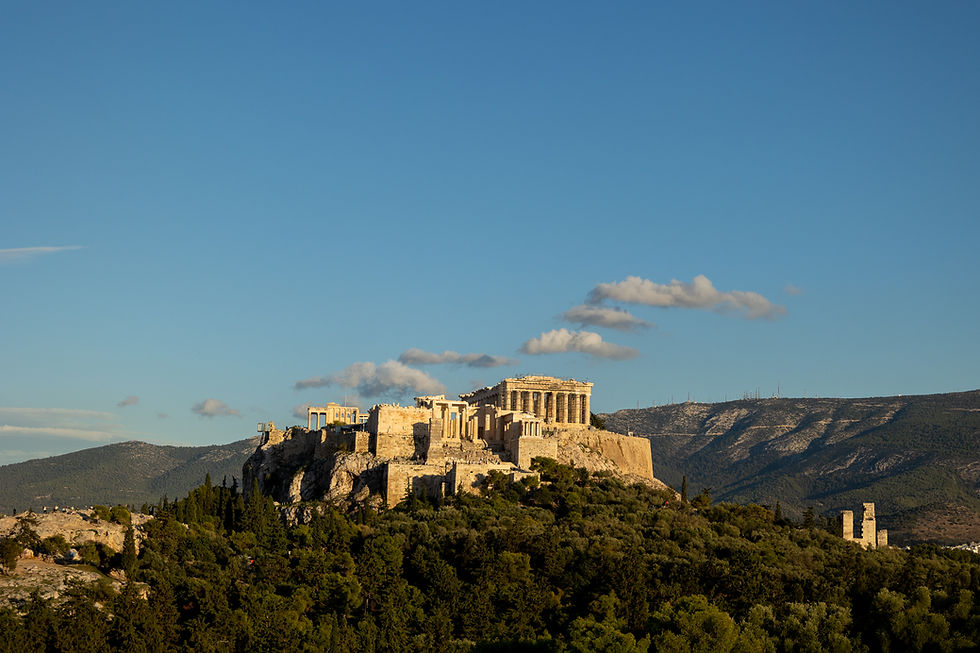
The Parthenon is a magnificent example of ancient Greek architecture and engineering. The temple was constructed using marble, with the columns and walls intricately designed to withstand the test of time. The temple's pediments, metopes, and friezes were decorated with detailed sculptures that tell the story of Athens and its myths.
When you go to purchase a ticket, if they ask you if you want all or just one, they are asking if you want to see all the ruins and landmarks in Greece for around $30 CAD or just one for around $12 CAD. The 'all' ticket gives you access to around 6 different ruins and locations. If you are there for a short period of time, I would recommend just buying one for the Parthenon. If you feel you will have time, buy it for all or you can always buy at each location, but I believe after three locations is when it starts to add up and exceed the price for all.
Once through the gate, situated next to the Parthenon in Athens is the world-renowned Amphitheater, also known as the Odeon of Herodes Atticus. Amphitheater, also known as the Odeon of Herodes Atticus.

Built in 161 AD by the wealthy Roman Herodes Atticus, the theater was primarily used for musical events and other performances. It is a magnificent structure made of marble and stone, and it
can hold up to 5,000 spectators. The Amphitheater has hosted several famous musicians and performers, including Maria Callas, Frank Sinatra, and Elton John. Today, it is still used for musical and theatrical performances during the annual Athens and Epidaurus Festival, making it an essential part of Athens' cultural heritage. The Amphitheater is also a popular tourist attraction, offering visitors a chance to experience ancient Greek architecture and culture in a modern context.
As you continue towards the Parthenon, one of the most impressive features of the Parthenon is its size. The temple is 69.5 meters long, 30.9 meters wide, and 13.72 meters tall. Its massive columns, standing at over 10 meters tall, create an imposing and grand presence. The temple's unique design features a slight curve, which adds to its grandeur and creates a sense of harmony.

Visiting the Parthenon is a must-do activity when in Athens. The temple offers breathtaking views of the city, and it's a great opportunity to learn about ancient Greek history and culture. There are guided tours available that provide in-depth knowledge about the temple's history, architecture, and significance. Visitors can also explore the nearby Acropolis Museum, which houses many of the original sculptures and artifacts from the Parthenon.
Despite its grandeur and importance, the Parthenon has faced many challenges throughout history. The temple was damaged during the Peloponnesian War, and later, it was converted into a Christian church by the Byzantine Empire. During the Ottoman Empire, the temple was turned into a mosque, and the famous minaret was added to the structure. In 1687, the Parthenon was heavily damaged when it was hit by a cannonball during a war between the Ottoman Empire and the Venetians.
Over the years, Greece has been trying to get back ancient artifacts from the British Museum for decades. One of the most notable items that Greece has been seeking the return of is the Parthenon Marbles, also known as the Elgin Marbles. These marble sculptures and friezes were originally part of the Parthenon temple in Athens and were removed by Lord Elgin, the British ambassador to the Ottoman Empire, in the early 19th century. Greece argues that the sculptures were taken illegally and should be returned to their rightful place in Athens. However, the British Museum maintains that the sculptures were obtained legally and that they are part of a world heritage collection that should be shared by all.

Surprisingly, in Nashville, Texas, USA, there is a complete reconstruction of the Parthenon where you are able to see what it would have looked like Elgin Marbles and all! Don't worry though, the Parthenon still presents pieces of its ruins with pride.

Today, the Parthenon is a UNESCO World Heritage Site and a symbol of Greek culture and history. Its significance and beauty continue to inspire visitors from all over the world, and it remains a symbol of the incredible achievements of ancient Greek civilization. A visit to Athens is incomplete without experiencing the awe-inspiring beauty of the Parthenon.

Comments